
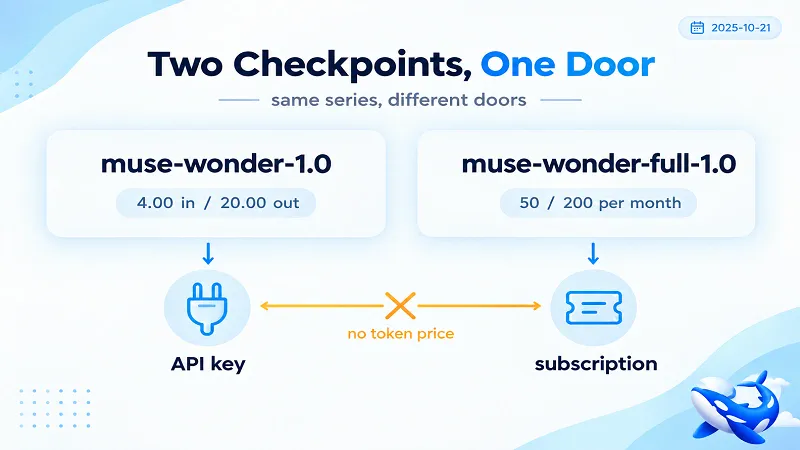
Muse Wonder shipped on 2026-10-12 as a series rather than a model, and the two members of that series are bought in different currencies — a split documented on OrcaRouter in the muse wonder launch write-up, whose figures are the vendor’s published rates and plans [VENDOR].
The vendor serves the `muse-wonder-1.0` checkpoint through its API and within its terminal coding agent. It bills at $4.00 per million input tokens and $20.00 per million output, with cached input at $0.20 — which the independent evaluator Artificial Analysis reads as a 95 percent cache discount, and which produces a blended cost near $2.94 per million at a 7:2:1 mix [INDEPENDENT].
`muse-wonder-full-1.0` is the checkpoint the vendor describes as the higher-scoring configuration. It has no per-token price at all. A coding-agent subscription offers it for $50 a month with Power Usage and $200 a month with Maximum Usage [VENDOR].
That is the whole access story, and it is worth stating as bluntly as it was on launch day: one of the two checkpoints opens with an API key and the other does not.
What “no per-token price” actually rules out
It rules out a specific and very common workflow: benchmarking the API model, deciding it is good, and then turning a dial to get the better one.
There is no dial. Full is not an effort flag on the API model, not a second endpoint behind the same key, and not a tier you upgrade into by spending more tokens. It is a separate checkpoint behind a separate product, and the unit of purchase is a seat-month rather than a million tokens.
That distinction changes the shape of a cost comparison in a way percentages cannot capture. A token-priced model scales with usage; a seat-month does not. At ten thousand calls a month the API checkpoint is cheap and the subscription is expensive; at a hundred thousand calls the relationship may invert; at some volume there is a crossover, and the crossover is the only thing a buyer actually needs to compute.
The vendor does not disclose how many calls each subscription includes, so we cannot calculate the crossover using publicly available information. We can, however, describe the overall pattern: the API path scales linearly with tokens, while the Full path charges a flat rate per seat. The crossover point depends on your traffic.
The score gap and what it is worth
The vendor publishes a benchmark table covering both checkpoints at their maximum reasoning settings, and it is the only scoreboard that covers Full at all [VENDOR]. On the composite index it publishes, the series carries 59.0 for Full.
The independent evaluator, running the same harness for every model on its board with a published configuration and no vendor input, reads 56 for Full and 52 for the API checkpoint at maximum effort [INDEPENDENT].
Three points between the vendor’s 59.0 and the independent 56 on the same checkpoint is not a rounding difference, and the independent figure is the one to plan against, because it is measured under conditions you could reproduce.
But the more useful observation is internal to the vendor’s own table: Full is not uniformly better than the cheaper API checkpoint. The two profiles trade rows. On the sustained-agent benchmarks the vendor promotes, Full leads; elsewhere the two are close or reversed. That pattern suggests two different training objectives rather than one dial turned up, and it means “Full is the better model” is not a safe assumption for your own workload.
If the profiles trade rows, then the honest way to choose is to measure both — which currently means buying the subscription. That is a real cost, and it is a cost the vendor has chosen to impose by packaging the better-scoring checkpoint behind a seat.
The envelope, and the one line that is genuinely unusual
Both checkpoints share a large envelope: 1,048,576 tokens of context, up to 943,718 tokens in a single response, input in text, image, speech and video against text output, and reasoning that is mandatory — an effort ladder from minimal to max with a default of medium and no off switch [VENDOR].
That last item has a cost consequence that does not appear in any rate card. A model that cannot stop thinking when instructed will spend reasoning tokens on every request, and these tokens count as output tokens. A simple classification that would cost a few cents on a model with an off switch costs whatever the mandatory thought process costs here.
The single most unusual line in the rate card is not a rate. It is the statement that the input price does not step at a token threshold: a 400,000-token prompt bills at the same per-token rate as a 400-token one [VENDOR]. Several flagships re-price the whole request once a prompt crosses a documented boundary, which makes long-prompt work disproportionately expensive on those models. Here the curve is flat, and that is a genuine difference in the shape of the cost function rather than in its height.
For anyone doing retrieval over large documents or long agent transcripts, a flat curve is worth more than a slightly lower rate, because it removes the cliff that makes a 200,000-token prompt cost four times what a 100,000-token one does.
Where our own catalogue stands, stated plainly
It is worth being explicit about one thing, because a reader arriving from a search engine will reasonably assume otherwise: Muse Wonder is not in the OrcaRouter catalogue [OURS].
The Meta provider page carries two models, Muse Spark 1.1 and Muse Spark 1.2, both at $1.25 input and $4.25 output with a $0.150 cached rate and a 1M context window [VENDOR rates, OURS catalogue]. Muse Wonder is a different family from a different release, and it is not served here.
That matters for two reasons. First, it means a reader cannot route Muse Wonder calls through the gateway today, and an article that implied otherwise would be selling something that does not exist. Second, it means the interesting comparison is not “Wonder versus Spark” on price — it is the shape of the two access models, which is the subject of this piece.
The Spark rows are still useful as a reference point, because they show what a token-priced Muse model looks like on a rate card: a flat $1.25/$4.25 with a cache discount to $0.150. Wonder’s API checkpoint at $4.00/$20.00 is roughly three times the input rate and nearly five times the output rate of that reference, with a comparable cache discount in percentage terms.
How to think about a two-door release
Four questions, in the order that resolves the fastest.
Which checkpoint do you actually need? If your work does not involve sustained agents or long-horizon tasks, the vendor’s own table shows that the profiles perform differently across categories, and you may find the API checkpoint a better fit regardless of price.
Is your volume linear or bursty? A seat-month is a fixed cost and a token rate is a variable one. A team with steady traffic and a budget line prefers the second; a team with a bursty month and a fixed headcount prefers the first.
Does the mandatory reasoning fit your task? A model that always thinks is a poor fit for classification at scale and a good fit for anything that benefits from deliberation. The rate card does not discount by task type.
Check the flat input curve against your prompt lengths. If your prompts run to hundreds of thousands of tokens, a provider that does not re-price at thresholds is worth more than one that does, and the difference can exceed the headline rate gap.
A two-door release is not a marketing stunt; it is a statement about which customer the vendor wants on which side. Reading it as a pricing anomaly misses the point, and reading it as a single model with two prices misses the structure entirely.